
Scaleport For Investors
The Industrial Gearbox.
Ecosystem-as-a-Service infrastructure connecting robotics and drone companies to $2T in industrial assets.
The Investment Thesis
Market Failure.
Repeatable Infrastructure.
CVC-Aligned Returns.
The industrial robotics sector has a commercialization problem. Over 300 inspection robotics and drone companies are commercially ready but structurally blocked from reaching the industrial asset owners who need their technology. Scaleport is the shared infrastructure layer that closes that gap. The business generates recurring membership revenue, services margin, and referral income — while simultaneously de-risking the portfolio companies CVC investors have already backed. Two return vectors, one investment.

Market Opportunity
A $2T Industrial Asset Base. 70% of Infrastructure Over 25 Years Old.
- $2T+ global industrial inspection and maintenance market
- 70% of critical assets in North America and Europe exceed 25 years of age
- 34% of global industrial downtime attributed to aging assets
- 300+ commercially ready inspection robotics companies cannot scale locally
- Houston alone: 44% of US petrochemical capacity, 9 major refineries
Business Model
Recurring Membership + Services + LaunchPad. Three Revenue Streams.
- Tier 1–3 monthly memberships: $950–$20,000/month per member
- Services margin: logistics, wash-down, demo scheduling, customs
- LaunchPad one-time fee per member + partner referral commissions
- Target: 25% EBITDA margin at hub break-even (8–12 members)
- Repeatable template: Houston model replicates to Rotterdam, Dubai, Singapore

CVC Strategic Value
Your Portfolio Companies Need This Infrastructure to Survive.
- 85% reduction in commercialization burn rate for portfolio companies
- Scaleport is the reason a portfolio company closes its first US contract
- Innovation Outpost: dedicated hub presence for CVC deal flow and monitoring
- De-risks the #1 failure mode: failure to scale commercially and support locally
- Portfolio company word-of-mouth drives inbound member pipeline
For Investors
Six Reasons Scaleport Belongs in Your Portfolio
CVC or financial VC — the thesis holds from both angles.

01 / MARKET STRUCTURE
"This Is Not a Co-Working Space. It Is the Missing Infrastructure Layer for a $2T Market."
The global industrial inspection and maintenance market exceeds $2 trillion. The technology to serve it exists — over 300 commercially ready inspection robotics and drone companies are actively seeking industrial customers. The missing layer is not technology. It is the shared physical and operational infrastructure that allows those companies to operate locally at a fraction of standalone cost. Scaleport is that infrastructure layer, positioned at the intersection of the world’s most valuable industrial clusters.

02 / RECURRING REVENUE
"Multi-Year Memberships. Services Margin. Referral Commissions. Three Compounding Streams."
Scaleport generates revenue across three streams. Tier 1 to 3 memberships create predictable monthly recurring revenue at $950 to $20,000 per member. Hub services, logistics coordination, customs brokerage, wash-down, demo scheduling generate margin on every member event. LaunchPad generates one-time fees of $6,000 to $9,000 per engagement plus ongoing referral commissions from G&A Partners, Archer Commercial, Foothold America, and Texas Capital Bank. At break-even (8–12 members per hub), the model targets 25% EBITDA margins.

03 / CVC PORTFOLIO VALUE
"Every Dollar Your Portfolio Company Saves on Market Entry Is a Dollar Back Into R&D."
Scaleport reduces the commercialization burn rate for industrial hardware companies by an estimated 85%. A standalone Houston market entry costs $500K to $1M in Year 1. Scaleport membership delivers the same operational footprint at a fraction of that cost. For a CVC investor with 5 to 10 portfolio companies attempting US market entry, Scaleport is direct runway extension — an infrastructure investment that pays for itself through portfolio company performance before the first strategic return is counted.

04 / TRACTION & VALIDATION
"LOIs From Tier-1 Inspection Robotics Companies. Market Demand Confirmed Before Hub Opens."
Scaleport is securing Letters of Intent from target member companies before the Houston hub opens — a standard CVC diligence signal that demand exists at viable pricing. The founding team brings direct credibility in the market from Waygate Technologies and Baker Hughes, Energy Drone and Robotics Coalition (EDRC), and from Dow Chemical. The EDRC network alone represents the most concentrated sourcing engine for qualified inspection robotics companies in North America.

05 / DEFENSIBILITY
"Technology Insights, Industrial Relationships, and Physical Infrastructure. This Cannot Be App'd Away."
Scaleport’s moat is not software. It is the combination of experience, physical industrial-grade infrastructure in proximity to the world’s most valuable energy clusters, a founding team with direct buy-side relationships at major O&G operators, and a member network that grows more valuable as each new company joins. A digital platform cannot provide a certified ATEX testing environment, coordinate the customs clearance of contaminated inspection equipment, or introduce a Swiss robotics company to a Shell procurement manager by name. Scaleport can.
06 / SCALE TEMPLATE
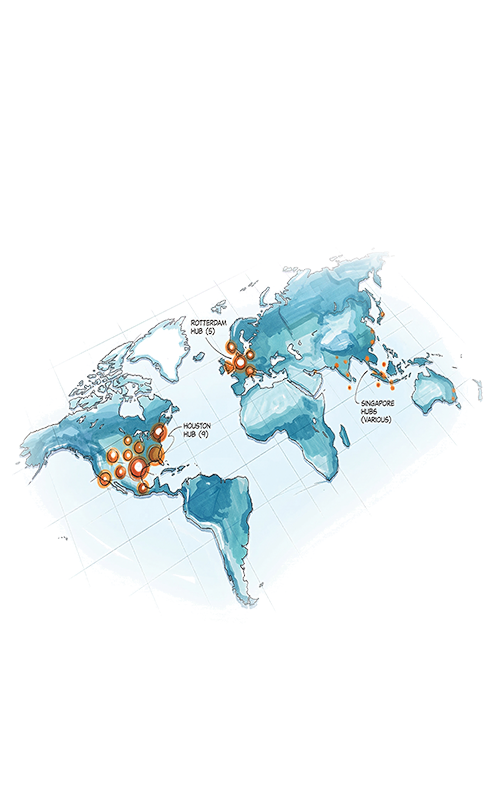
"Houston Is Hub One. Rotterdam, Singapore, and Beyond Follow the Same Model."
The Scaleport model is designed for replication. The Houston hub establishes the operating template: lease structure, membership tiers, logistics SOPs, LaunchPad service delivery, and partner network. Every subsequent hub — Dubai, Rotterdam, Singapore — deploys the same template with local adaptation. The valuation at $3M EBITDA across three hubs ranges from $24M to $75M depending on revenue quality and strategic buyer appetite. CVCs investing at seed participate in both the infrastructure returns and the strategic value of an industry-standard platform.
FAQ
Your Questions Answered
Common questions we hear before every signup.
What is Scaleport's investment thesis?
The global industrial inspection and maintenance market exceeds $2 trillion, with 70% of critical assets in North America and Europe over 25 years old and demanding inspection, monitoring, and maintenance technology. Over 300 commercially ready robotics and drone companies are actively seeking these industrial customers but cannot scale locally because the cost of standalone market entry exceeds $500,000 per geography. Scaleport is the shared infrastructure layer that resolves this. Members access a permanent industrial-grade hub inside the highest-density industrial cluster in the world, at a fraction of the standalone cost. The investment thesis is simple: own the infrastructure layer of a $2T market that the technology cannot reach without it.
How much is Scaleport raising and what are the terms?
Scaleport is currently raising a seed round to fund the Houston flagship hub, the European satellite operation in Singen, and operations through to break-even. Round size, structure, and terms are shared with qualified investors under NDA. The use of funds includes hub fit-out, founding team compensation, working capital through hub launch, and the operational reserve required to reach break-even occupancy. To request the data room, full investor memorandum, financial model, and term sheet, contact the founding team through the request button on this page.
What is Scaleport's revenue model and unit economics?
Scaleport generates revenue across three streams. Tier 1 to 3 monthly memberships create predictable recurring revenue at $950 to $20,000 per member with multi-year commitments. Hub services — logistics coordination, customs brokerage, equipment wash-down, demo scheduling, and tradeshow support — generate margin on every member event and turnaround cycle. LaunchPad delivers one-time market entry fees plus ongoing referral commissions from a curated partner network. At hub break-even (8-12 active members per location), the model targets 25% EBITDA margins, scaling to 35%+ at network maturity as HoldCo overhead is absorbed across multiple hubs. The five-year cumulative free cash flow projection for a single Houston hub at 75% occupancy is in the multi-million range after fit-out CapEx.
What traction does Scaleport have before the Houston hub opens?
Scaleport is securing Letters of Intent from target member companies before the Houston hub opens — a standard CVC diligence signal that demand exists at viable pricing. Founding team relationships across the inspection robotics ecosystem provide an active member pipeline including Swiss, German, and US companies in the ETH Zurich, EDRC, and broader industrial robotics networks. The Houston facility lease has been negotiated at Port 225, Building 6, Suite 170 in Pasadena, TX — 27,854 square feet of industrial warehouse and office space directly on the Pasadena Freeway corridor. Marty Robinson serves as Senior Advisor to the Energy Drone & Robotics Coalition (EDRC), providing direct sourcing access to the most concentrated network of qualified inspection robotics companies in North America.
How does Scaleport create value for CVC investors specifically?
Scaleport provides a strategic multiplier for corporate venture portfolios in oil and gas, petrochemicals, and industrial automation. The value operates on three levels. First, capital efficiency: every dollar a portfolio company spends on standalone field offices, remote admin staff, or customs paperwork is a dollar not spent on product development. Scaleport reduces commercialization burn by an estimated 85% and extends the operational runway of hardware investments CVCs have already funded. Second, portfolio de-risking: the primary failure mode for industrial hardware startups is not technology, it is the inability to scale commercially. Scaleport provides the infrastructure that prevents this failure. Third, the flywheel: the hub generates bottom-up pull from local plant managers and procurement teams encountering member technology daily, while a CVC relationship adds top-down acceleration by directing portfolio companies into the ecosystem.
What is Scaleport's defensibility and moat?
Scaleport’s moat is not software. It is the combination of physical industrial-grade infrastructure in proximity to the world’s most valuable energy clusters, a founding team with direct buy-side relationships at major oil and gas operators, a member network that grows more valuable as each new company joins, and direct integration with the Energy Drone & Robotics Coalition. A digital platform cannot provide a certified ATEX testing environment, coordinate the customs clearance of contaminated inspection equipment, or introduce a Swiss robotics company to a Shell procurement manager by name. The combination of physical assets, industry relationships, and operational expertise compounds with every additional member and every additional hub.
How does Scaleport scale beyond Houston?
The Scaleport model is designed for replication. The Houston hub establishes the operating template: lease structure, membership tiers, logistics SOPs, LaunchPad service delivery, and partner network. Every subsequent hub follows the same template with local adaptation. Singen launches in parallel as a lean European satellite operation. Rotterdam, Dubai, and Singapore are scoped at the strategic level and require minimal additional seed capital — lease negotiations begin once Houston reaches 60%+ occupancy, projected by Month 7. At three hubs and $3M EBITDA, the blended valuation range is $24M to $75M depending on revenue quality, growth rate, and strategic buyer presence. The path to scale is capital-light because every additional hub reuses the proven Houston template.
Who is the founding team and why is this team uniquely positioned?
The founding team has lived every version of the Proximity Gap. Viktor Klein, CEO, is the former Sales Director Robotics at Waygate Technologies and Baker Hughes, and Head of Product at GE Inspection Robotics. He built and scaled commercial robotics operations across Europe and the Americas, originated the Scaleport concept, and leads investor relations and member acquisition. Marty Robinson, CTO, is a former Senior Robotics Manager at Dow Chemical with two decades leading robotics development across global petrochemical operations, and Senior Advisor to the Energy Drone & Robotics Coalition. Andy Lewis, CFO, is a former Maintenance Director and Global Improvement Leader at Dow Chemical with 20+ years leading reliability for world-scale industrial facilities. Combined, the team brings more than 60 years of industrial operations, robotics commercialization, and asset owner procurement experience.